
 Français
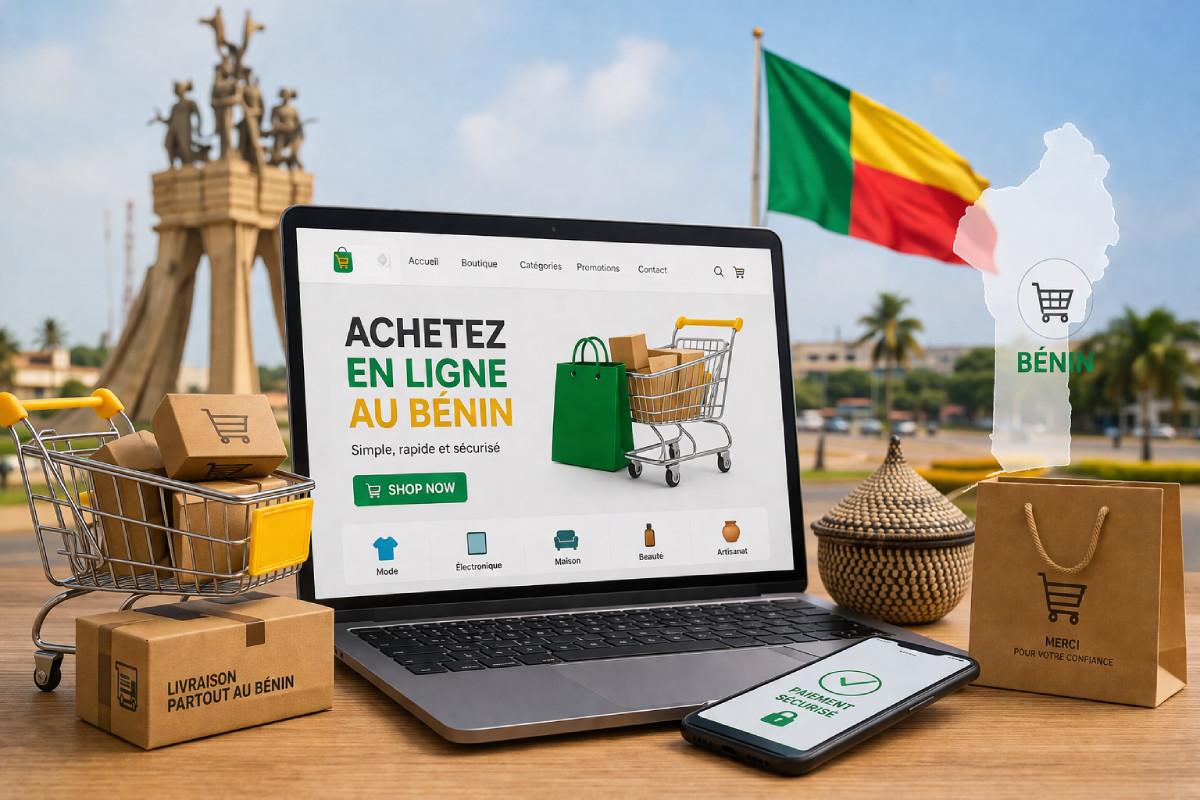
African e-commerce is expected to grow from 55 billion dollars in 2024 to over 112 billion by 2029. Benin, with its national e-commerce development strategy for 2025-2029, its 4.8 million internet users, and the explosion of Mobile Money, is riding this wave.
Yet the vast majority of Beninese merchants still sell exclusively through social media — WhatsApp, Facebook, Instagram — without a proper e-commerce website. That approach works at the beginning, but it quickly hits its limits when you need to manage a product catalog, track orders, accept secure payments, and reach customers beyond your personal network.
In this guide, we show you step by step how to move from informal selling on social media to a professional online store, adapted to the realities of the Beninese market.
Why Sell Online in Benin in 2026?
The market is ready
Benin has approximately 4.8 million internet users, with a mobile penetration rate of 33.8% according to the International Telecommunication Union. Over 90% of web traffic comes from mobile phones. Beninese consumers are increasingly searching, comparing, and buying from their smartphones.
The Beninese government itself is betting on e-commerce as a development driver. The national strategy for 2025-2029, approved in December 2024, aims to position Benin as a digital services platform in West Africa.
Payment solutions exist
The main barrier to e-commerce in Africa — payment — is largely solved in Benin. MTN MoMo and Moov Money are used by millions of people daily. MTN MoMo celebrates 15 years in Benin and has enabled over 2 million Beninese to access digital microcredit. Payment gateways like KKiaPay, FedaPay, and PayDunya make it easy to integrate Mobile Money into an e-commerce site.
Online competition is still low
This is the key point. Most Beninese merchants don't yet have a real e-commerce website. Those who start now gain a considerable head start, in terms of Google visibility, professional credibility, and the ability to reach customers beyond their city or WhatsApp network.
E-Commerce Website vs Social Media: What Should You Choose?
Many Beninese entrepreneurs start selling on Facebook or WhatsApp. It's a good starting point, but it's not enough to build a sustainable business.
What social media does well
It gives you an immediate audience. You can post product photos, interact with customers in real time, and receive orders via messages. It's free, fast, and familiar. For testing a product or starting with zero budget, it's ideal.
What social media doesn't do
It doesn't belong to you. Facebook can change its algorithm tomorrow and your visibility drops to zero. You don't control the layout, the buying journey, or the customer data. There's no structured catalog, no inventory management, no automated order tracking, no integrated payment. And most importantly, a Facebook account doesn't appear in Google search results when someone searches for your products.
The right strategy: use both together
Your e-commerce website is your base. Your permanent store that belongs to you. Social media channels are your promotional tools. They drive traffic to your site. This is exactly the strategy we implemented for Location Facile, where every listing published on the site is automatically shared on WhatsApp and Facebook.
Choosing the Right Technical Solution
Option 1: Turnkey platforms (Shopify, WooCommerce)
Shopify is the world's most well-known e-commerce platform. It's easy to use, hosted, and offers dozens of themes. But it costs between 15,000 and 200,000 FCFA per month (subscription + sales commission), customization options are limited, and integration with local payment solutions (MTN MoMo, Moov Money) isn't native. You need third-party plugins.
WooCommerce (WordPress) is free in itself, but requires hosting, paid plugins, and technical skills for maintenance and security. The quality of the result depends heavily on the person installing it.
Verdict: these solutions work if you have a small catalog, a limited budget, and you accept the constraints of a standard template.
Option 2: Custom development
A custom-built e-commerce site using technologies like Symfony, React, or Vue.js offers total freedom: unique design, a buying journey optimized for your clientele, native integration of Beninese payment solutions, and the ability to scale without limits.
Verdict: this is the recommended option for businesses that want a high-performing, differentiated site that can grow with them. The initial cost is higher, but the result is a tailor-made business tool.
For a detailed cost comparison, check our guide: How much does a website cost in Benin in 2026?
Integrating Online Payment in Benin
This is the crux of the matter. If your customers can't pay easily, they won't buy.
Available payment solutions
| Solution | Mobile Money | Bank cards | Coverage | Integration |
|---|---|---|---|---|
| KKiaPay | MTN MoMo, Moov Money | Visa, Mastercard | Benin + international | Simple API, clear documentation |
| FedaPay | MTN MoMo, Moov Money | Visa, Mastercard | Benin + WAEMU | REST API, plugins available |
| PayDunya | MTN MoMo, Moov Money, Orange Money | Visa, Mastercard | West Africa | API + WooCommerce plugins |
What your customers expect
In Benin, Mobile Money is the dominant payment method, far ahead of bank cards. Your site should offer MTN MoMo and Moov Money payment as a priority. Visa/Mastercard cards are a useful complement for the diaspora and international customers.
Practical tips
Always offer at least two payment methods. Clearly display the logos of accepted payment methods on your product page and checkout page, it reassures customers. And if your target audience includes customers who don't want to pay online, offer cash on delivery as an additional option.
Organizing Delivery
Delivery is often the weakest link in West African e-commerce. But solutions exist in Benin.
Delivery options
Delivery by your own means. For a local start (Cotonou, Abomey-Calavi), you can handle deliveries yourself or with a dedicated courier. It's the simplest and least expensive solution at the beginning.
Partner delivery services. Several courier and delivery services operate in Benin. You can negotiate flat rates and integrate delivery cost calculations directly into your site.
Pickup points. Offering one or more pickup points (your physical store, a partner location) is an excellent alternative. It reduces your delivery costs and reassures customers who prefer to see the product before paying.
Practical tips
Display delivery fees clearly before the checkout page. Hidden fees are the number one cause of cart abandonment. Offer free delivery above a certain amount if your margins allow it. And give a realistic delivery time estimate. It's better to say "48 to 72 hours" and deliver in 48h than to promise "24 hours" and deliver in 3 days.
Writing Product Pages That Sell
The product page is the most important page on your e-commerce site. It's what convinces the visitor to buy, or to leave.
Essential elements
Quality photos. Multiple angles, clean background, good lighting. On mobile (90% of your traffic), photos are the first thing the customer sees. You don't need a professional studio, a recent smartphone and natural light are enough.
A descriptive, optimized title. Not just "Blue dress." Rather, "Blue wax dress — size M — delivery Cotonou." The title should contain the words your customers type into Google.
A description that answers questions. Material, dimensions, size, available colors, care instructions, delivery time. Every unanswered question is a reason not to buy.
The price clearly displayed in FCFA. No "contact us for the price." If the customer has to message you to find out the price, you lose 80% of your potential buyers.
A visible buy button. Large, colored, with clear text: "Add to cart" or "Order now."
The classic mistake in Benin
Many Beninese online stores copy the supplier's description (often in English or poorly translated Chinese). This is a major SEO mistake: Google detects duplicate content and won't rank it. And it's a business mistake: the customer doesn't feel concerned. Write your own descriptions, in French, thinking about your Beninese customer.
Making Your Store Visible on Google
An e-commerce site without SEO is like a catalogue that nobody ever opens: your products exist, but they never appear when a customer searches for them on Google.
E-commerce SEO basics
Optimized category pages. Each product category should have a unique title, a description, and relevant content. "Men's shoes Benin" is better than just "Shoes."
Unique product pages. Each product should have its own URL, its own title, and its own description, never duplicate content.
An active blog. Publishing articles related to your products (buying guides, comparisons, trends) attracts qualified traffic and strengthens your authority on Google. To learn more, check our SEO guide for Beninese businesses.
A fast, mobile-first site. If your site takes more than 3 seconds to load on a smartphone with a Beninese 4G connection, you lose customers and Google rankings.
Google Business Profile
Even for an e-commerce business, having a Google Business Profile is essential if you have a physical address (store, warehouse, pickup point). It gives you local visibility and builds trust.
Promoting Your Online Store
Social media (free)
Facebook and Instagram remain the most effective channels in Benin for promoting an online store. Regularly post product photos, customer testimonials, and promotions. Always direct people to your site for the purchase, not to a WhatsApp message.
WhatsApp Business (free)
Create a WhatsApp Business catalog with your products and a link to your site. Use WhatsApp statuses to showcase new arrivals and behind-the-scenes content. WhatsApp is the most direct channel in Benin, make the most of it.
Facebook/Instagram advertising (paid)
With a budget of 5,000 to 20,000 FCFA per day, you can precisely target people in your area (Cotonou, Abomey-Calavi, Porto-Novo) and drive them to your site. It's the fastest lever to generate your first sales.
SEO (free, long-term)
Search engine optimization takes time, but it's the most profitable channel over the long run. Every optimized page and every blog article is a client magnet that works for you 24/7.
Your 5-Step Action Plan
Don't try to do everything at once. Here's a realistic plan to launch your e-commerce store in Benin.
Step 1: Validate your offer on social media. Before investing in a website, test your products on Facebook and WhatsApp. If you already have regular sales, you're ready for an e-commerce site.
Step 2: Choose your technical solution and payment gateway. Turnkey platform or custom development? KKiaPay, FedaPay, or PayDunya? Make this decision based on your budget, your catalog, and your ambitions.
Step 3: Build your site with quality product pages. Professional photos, unique descriptions in French, displayed prices, visible buy buttons. It's the content that sells, not the design.
Step 4: Organize delivery and launch. Start local (Cotonou, surrounding areas), with realistic timelines and transparent fees. You'll expand later.
Step 5: Promote and optimize. Social media for immediate traffic, SEO for lasting traffic. Analyze your sales, listen to your customers, and improve continuously.
Frequently asked questions
Do I need a business registration to sell online in Benin?
Yes, to legally conduct commercial activity in Benin, you must have a business registration (registre de commerce) and a tax identification number (IFU). This is essential to open a merchant account with payment gateways like KKiaPay or FedaPay. Business registration formalities in Benin can be completed online through the one-stop shop MonEntreprise.bj.
How much does it cost to create an e-commerce site in Benin?
Prices range from 150,000 FCFA (basic template solution) to over 3,000,000 FCFA (custom platform with advanced features). For a detailed comparison, check our guide on website creation costs in Benin.
Can I sell internationally from Benin?
Yes, it's actually one of the great advantages of an e-commerce website. By integrating Visa/Mastercard payments via KKiaPay or FedaPay, you can accept orders from the diaspora and international customers. International shipping requires a partnership with a suitable transport service.
What products sell best online in Benin?
Categories that perform well include fashion and clothing (wax, garments, accessories), cosmetic and hair care products, electronics and phone accessories, processed food products, and services (training, bookings). But what matters most isn't the category — it's the quality of your offer and your execution.
Do Beninese customers trust online payment?
Trust is growing rapidly, driven by the massive adoption of Mobile Money. Over 2 million Beninese already use digital microcredit via MTN MoMo. The key to inspiring trust on your site: display payment method logos, offer cash on delivery as an alternative, show customer reviews, and ensure your site uses HTTPS (SSL certificate).
Conclusion: The Time to Start Is Now
E-commerce in Benin is still in its early stages. The market is ready, payment solutions exist, connectivity is improving, and online competition is still low. Every month you wait is a month a competitor takes your place on Google.
You don't need a catalog of 500 products to get started. You need a well-built site, convincing product pages, a payment method that works, and a clear promotional strategy. The rest will come with your first sales and your customers' feedback.
At Dalcom SEO, we build custom e-commerce websites with Mobile Money integration, built-in SEO, and training for independent management. If you're ready to move from informal selling to professional online commerce, we're here to help.
→ Let's discuss your e-commerce project — free quote within 24 hours.